


Blog
One Base Context for Every Team and Agent
Part 5 of Knowledge Up, Context Down, about organization-wide knowledge. The base context every person and agent starts from.


New to this series? Start with the overview. Previous: part 4. Next: part 6.
The organization level
At this level I've run into two opposite problems.
Too little information. Teams don't have the information they need. They either make their own choices and decisions, or they wait a long time for an answer. Both slow down building.
Too much information. On a platform like Confluence, people keep adding pages. Over time there are multiple versions of the truth, and nobody knows which one is correct. An AI that reads all of it has the same problem, at scale.
The first problem needs better availability, the second needs curation. A small, curated base context helps with both: it makes the essentials easy to find, and it keeps them correct.
The question for this part: what should an organization define, so that people and agents start from the same information?
Order matters
If everyone gets an AI assistant with memory before shared context is defined, each person builds their own version. After a few months you have many personal memories that each work for their owner but don't agree with each other. When someone leaves, their AI memory leaves with them.
The alternative is to define a small shared layer first, so personal setups build on it. Once everyone has their own setup, agreeing on a shared one is much harder.
What belongs at this level
Keep it small. Three types of knowledge cover most of it.
- Vocabulary: internal terms that an outsider, or an AI, would misread. This is often the first place where AI output shows it doesn't know your organization.
- Standards: what applies to every team, such as reference architectures, approved platforms, and security and data rules.
- Active decisions: organization-wide choices that are in force now: strategy, priorities, policies, and what's out of scope. Team and project decisions stay at their own level.
You don't need to write this from scratch. Most of it already exists in good examples of past work. The task is to collect it and make it explicit.
Governance
At this level, knowledge management becomes a governance question. Four questions help you start:
- Who decides what is the official version? For example: one named person per topic.
- Who may add or change it? For example: contributors propose, the named owner approves.
- What may AI access? For example: never more than the person using it.
- How often is it reviewed? For example: quarterly, and whenever a decision changes.
Where this context lives depends on who owns it: version-controlled files for developer teams, or a curated Confluence or SharePoint space, synced to agents, for business teams.
Who reviews all of this without creating a bottleneck? That's a question about how knowledge moves between levels, so it's covered in Part 6 – The flow.
Tools for business teams
Most business and policy teams don't work in git repositories, and they don't need to. The same principles work in the tools they already use:
- One place for base context: a dedicated, curated space in Confluence or SharePoint, separate from the general wiki.
- Clear ownership: one named owner per page, shown at the top of the page.
- Curation: changes go through a review or approval step before they are published.
- Removing old versions: a review date on every page. Expired pages are archived, not left next to the new version.
- Access for AI: connect the curated space and the general wiki separately, each with its own purpose.
Curated and uncurated knowledge
The general wiki still has value. The point is to use the two differently:
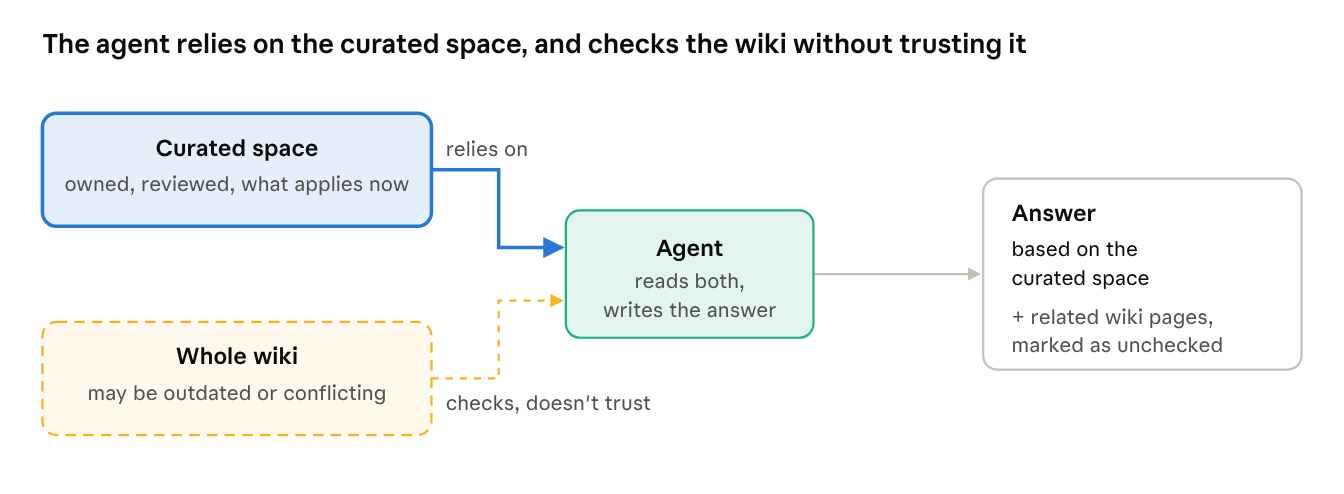
An agent can then answer from the curated space, and use the wider wiki only to point out that something related exists, with a note that it hasn't been checked. If agents treat the whole wiki as the truth, they inherit all its conflicting versions.
What the evidence says
This is not only my experience.
- Conflicting documents hurt AI answers. Research on retrieval-augmented models shows they are brittle when retrieved documents contain misleading or conflicting information (Why So Gullible?). A 2025 study found that standard approaches got worse as documents supporting one answer started to outnumber those supporting another (RAG with Conflicting Evidence). Multiple versions of the truth are not just confusing for people.
- Metadata helps. In one enterprise retrieval study, adding LLM-generated metadata (topic, technical and content tags) to document chunks, together with a better chunking method, raised retrieval precision from 73.3% to 82.5% (Mishra et al., 2025).
- Foundations decide AI outcomes. In a survey of 353 data and AI leaders, Gartner found that organizations with successful AI initiatives invest up to four times more in foundations such as data quality and governance. Gartner now calls context, including semantics and metadata, mission-critical for data and analytics (Gartner, 2026).
- Curation is becoming a role. APQC notes that AI depends on trustworthy, curated knowledge, and lists knowledge curator as an emerging role (APQC).
A practical tip for old versions: you don't always have to delete them, because some documents must be kept. Mark one copy as governing and tag the others as historical, so agents stop treating them as equal. That is exactly the conflict the research above warns about.
What not to include
Don't put everything the organization knows into the base context, and leave out personal preferences. The more you include, the harder it is to keep correct. A short base context that is correct is more useful than a long one that is partly outdated.
Open questions
- Who in your organization can say which version is the official one for a given topic?
- How do you change base context without breaking agents that depend on it?
For leaders: name an owner for the base context before you roll out AI assistants with memory, not after.
For developers: your repository knowledge builds on the organization's base context. Find out who owns the definitions your agents depend on.
Further reading for leaders:
- APQC, 2026 knowledge management predictions: where APQC expects KM to go, including new roles such as the knowledge curator.
- Mishra et al. (2025): how LLM-generated metadata improves enterprise search.
Next, part 6: When Knowledge Moves Up, Down or Out
Written by
Our Ideas
Explore More Blogs


Knowledge Up, Context Down
AI tools work better with the right context. This series covers four levels of knowledge, and when knowledge should move up, flow down or be removed.
Roel Bertens


Contact