


Blog
Knowledge Up, Context Down
A series on managing knowledge when working with AI.


When I work with AI tools, the quality of the result depends less on the model and more on the context it gets: which decisions were made, why, and what applies to this project, this team and this organization. Most AI tools now have some form of memory, but they don't decide what is correct, who owns it, or when it is outdated.
This series is about who decides that. Knowledge exists at four levels. What I find missing in most writing is how knowledge should move between those levels.
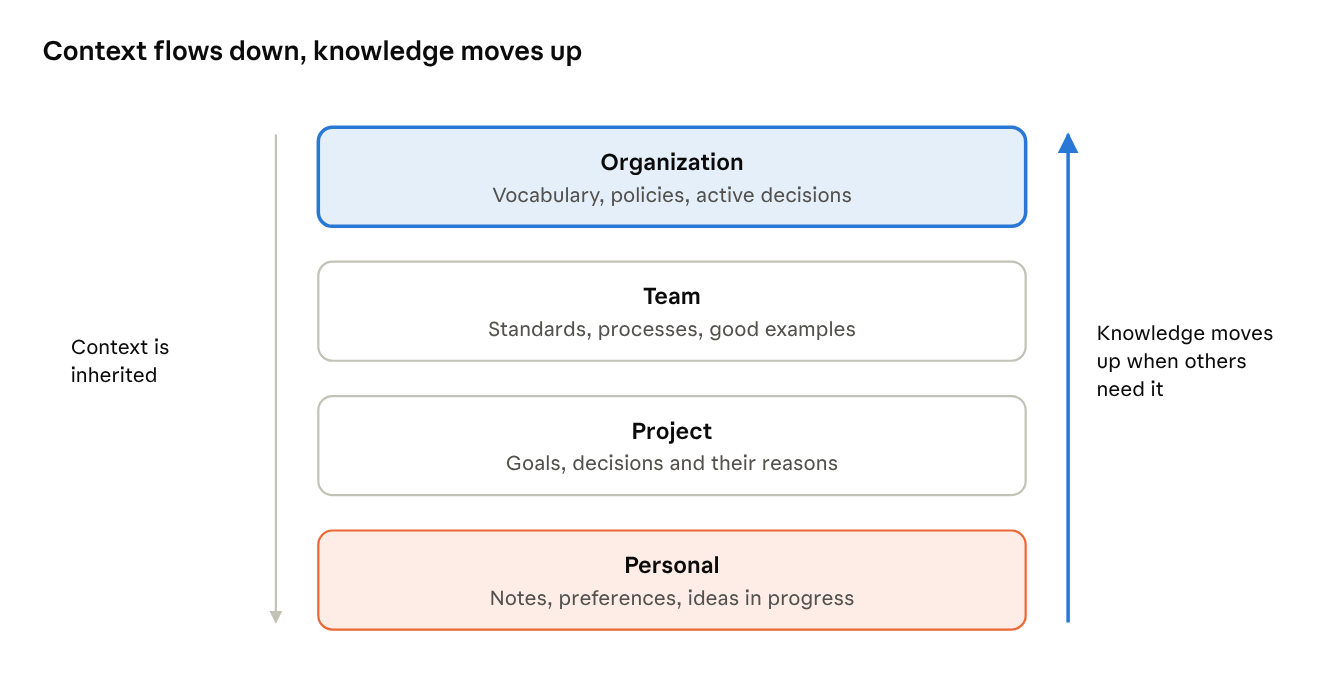
Context defined at a higher level applies to everything below it. Knowledge from a lower level moves up when there are clear signals that others need it.
Four levels of knowledge
- Personal: notes, preferences and drafts
- Owner: you
- Reliability: low, only checked by you
- AI uses it as: personal memory, instructions
- Project: goals, decisions and their reasons, status
- Owner: the project lead
- Reliability: medium, agreed in the project but may still change
- AI uses it as: project context, a decision log
- Team: standards, processes and good examples
- Owner: a knowledge steward
- Reliability: medium-high, reviewed by the team
- AI uses it as: shared memory, team skills
- Organization: vocabulary, policies and active decisions
- Owner: a named owner
- Reliability: high, curated and maintained for everyone
- AI uses it as: shared base context, loaded into every agent that needs it
Each level needs different tools and a different owner. An easy mistake is mixing them. One example: decisions the AI made stay in a personal chat, instead of being recorded for the project. Another: connecting the AI to all of Confluence as if it were curated organizational knowledge. Old and new pages then contradict each other, and the AI can't tell which one is current.
What this series adds
There is good existing work on these levels. Some authors describe knowledge moving upward, from personal notes to a company standard (Sprocket365, Tessl). Others argue the organization should define its context first, so lower levels can build on it (Summer Friday, Dubois). I think both are right, but neither gives practical guidance for both directions.
This series tries to fill that gap with simple guidance that doesn't depend on a specific tool: when knowledge moves up, how context is passed down, and when to remove it.
Where I mention tools, they're the ones my team uses: the Open Knowledge Format, kmctl and APM, among others. They are one worked example of how the ideas can be applied, not a requirement. If your team doesn't work in git, the same ideas work in a curated Confluence or SharePoint space with a clear owner (Part 5 – Organization).
The series
- Part 1 – The problem: Fast With AI, Lost Without Context
Fast results with AI, then losing track of decisions. - Part 2 – Personal: Your Own Context and When to Share It
Keeping your own context small, and sharing what's useful. - Part 3 – Project: Record Decisions and Their Reasons as You Go
Recording decisions and their reasons while you work. - Part 4 – Team: A Shared Way of Working That Everyone Can Check
Shared memory that people can inspect and correct. - Part 5 – Organization: One Base Context for Every Team and Agent
The base context every person and agent starts from. - Part 6 – The flow: When Knowledge Moves Up, Down or Out
When knowledge moves up, how context flows down, what to remove, and who reviews. - Part 7 – Putting it together: Where to Start With Knowledge for AI
A self-check, a minimal setup per level, and a look ahead.
Where to start
- If you're a developer working with AI coding tools
- If you lead a team
- If you're responsible for AI in your organization
Each part can be read on its own.
Written by
Our Ideas
Explore More Blogs


Fast With AI, Lost Without Context
AI makes you fast, but it doesn't keep track of why. Without recorded decisions and context, you get stuck or lost.
Roel Bertens


Contact