


2nd
Annual edition
Learn More About Our Company
Integrate Generative AI into your company

Transforming Banking with Cloud, Low-Code & Strategic Partnerships.

Move AI from pilots to production without losing control

Engineers work directly with business stakeholders to turn complex business problems into working solutions.


Data & AI Monitor: 2nd Edition
The Data & AI Monitor is Xebia’s annual research report on how organizations adopt, scale, and get value from Data & AI. Based on insights from 649 Data & AI professionals worldwide, the 2026 edition reveals a growing gap between AI adoption and business value.
2nd
Annual edition
649
Respondents worldwide
56
Survey questions
Using AI tools has become the easy part of the adoption journey but turning them into measurable business results is where most organizations get stuck.
Adoption is no longer the problem. Most teams already work with Generative AI assistants every day, yet fewer than half of them believe they are getting the full value out of it. Closing that gap is where the real opportunity lies.
The data points to three areas where organizations get stuck between using AI and getting value from it.
Most organizations are not ready for agents that act without a person checking each step.
Data quality remains the biggest barrier to AI adoption. The automated, consolidated infrastructure needed to address it often hasn't been built. Moving data to new infrastructure doesn't solve the problem if the underlying quality, governance, and structure remain unchanged.
Most organizations worry about who controls their data and AI, but very few have turned that concern into a plan.
Are dependent or highly dependent on third-party vendors such as cloud providers
Believe Big Tech holds too much power in Data & AI, up from 61% in 2025
Sovereign AI: the surprise runner-up among this year’s top trends, just behind AI agents
Have moved past exploring digital sovereignty into concrete action
Control is about what an organization chooses to manage directly, and where it accepts dependency. As AI moves from pilots into business-critical decisions organizations need to know where their data and models run, which dependencies they accept, and what happens when a provider becomes available.
The one gap in this report that’s actually shrinking.
Desired AI knowledge continues to rise every year. What's closing the gap is organizational readiness: where organizations make sustained investments in their people AI literacy is improving.
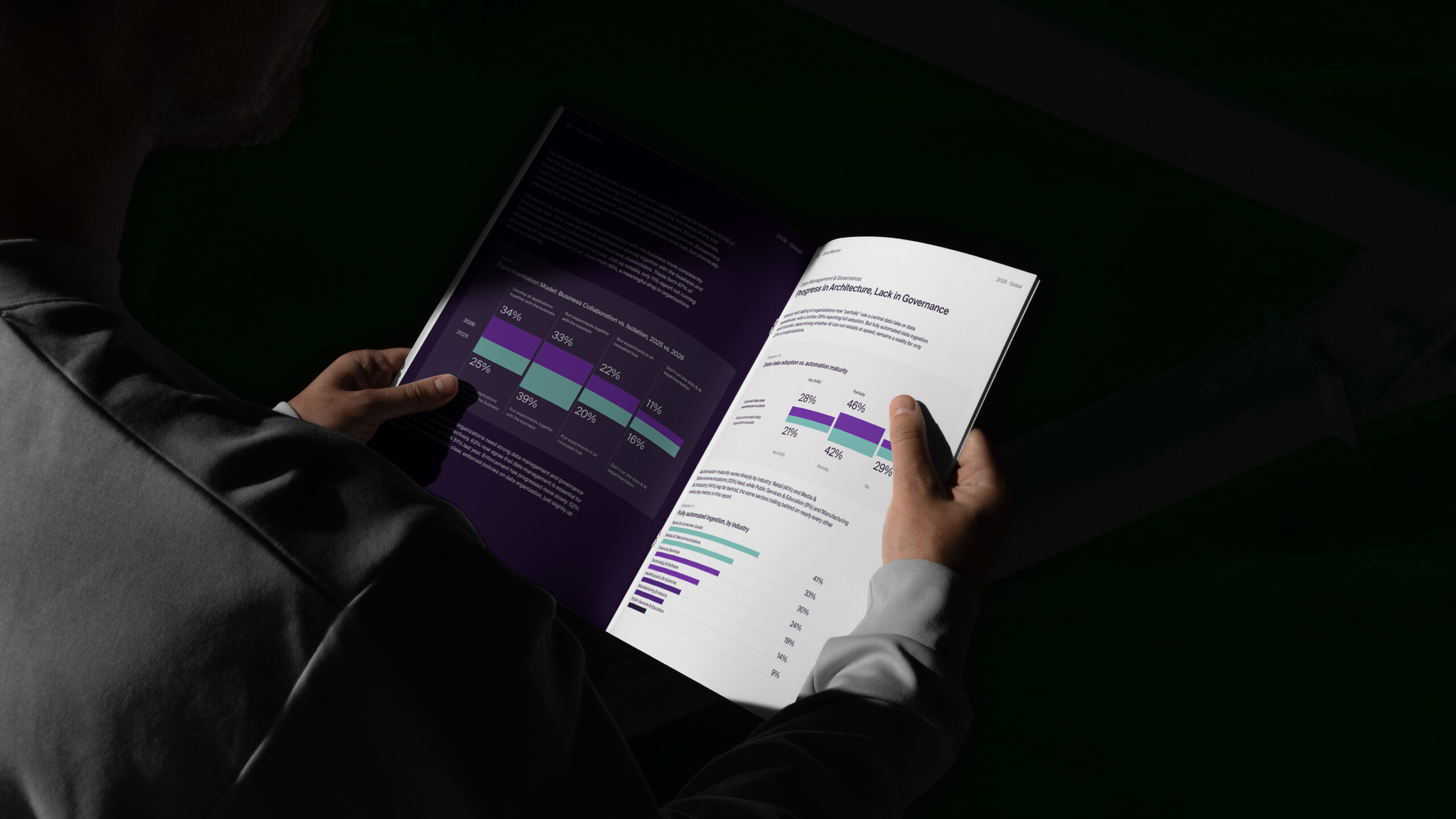
The Data & AI Monitor 2026 goes beyond these headline findings, looking at where organizations stand today, what’s changed since 2025, and what leaders should prioritize next.
Closing the gap takes more than new tools. These are the practical steps leaders can take now to turn AI ambition into measurable business outcomes.
Give every AI use case clear ownership, decision rights, and a measurable definition of success before development begins.
Improve data quality, automation, and governance before scaling AI further. A modern data stack it's the prerequisite for everything else on this list.
Know where your data and models run. Decide which dependencies are acceptable and build the ability to change direction without rebuilding everything.
Train leaders, employees, and developers differently, the skills a knowledge worker needs to use AI safely aren't the skills a developer needs to build with it.
Data & AI Benchmark by Xebia
Annual research tracking how organisations adopt, scale, and extract real value from Data & AI. Explore previous findings by sector, compare benchmarks year on year, and see where your organisation stands.

Data & AI Monitor: 2nd Edition
Research Partners
The platform where data and AI professionals come together to share knowledge, ideas and innovations. A two-day event focused on connection, inspiration and practical solutions.
The 2026 edition is based on responses from 649 Data & AI professionals worldwide. Respondents work at organizations of every size, from under 50 employees (29%) to 5,000 or more (24%). Most are based in the Netherlands (63%), followed by the United States (14%) and Germany (6%). The largest industries are Technology & Software (24%), Professional Services (13%), Financial Services (11%) and Public Services & Education (10%). Roles range from C-suite (19%) to data engineering, strategy, consultancy and IT.


