Agentic systems are moving beyond conversational and simple knowledge agents into operational workflows. They may support decisions, coordinate tasks, handle requests, trigger actions, or interact with enterprise systems. As adoption accelerates and these systems become part of mission-critical workflows, conversational fluency is no longer enough. A system may sound convincing and still make the wrong decision, take the wrong action, or behave inconsistently across similar situations. In agentic systems, reliability is rarely something you add through prompting alone. The real question is whether the system around the agent is testable, observable, and resilient when things go wrong. While observability is important in its own right, this post focuses specifically on testability and reliability, which should be discussed together. Both depend on how the system is designed: how work is decomposed, how outputs are validated, where humans stay in the loop, and how failures are contained.
Testable architecture
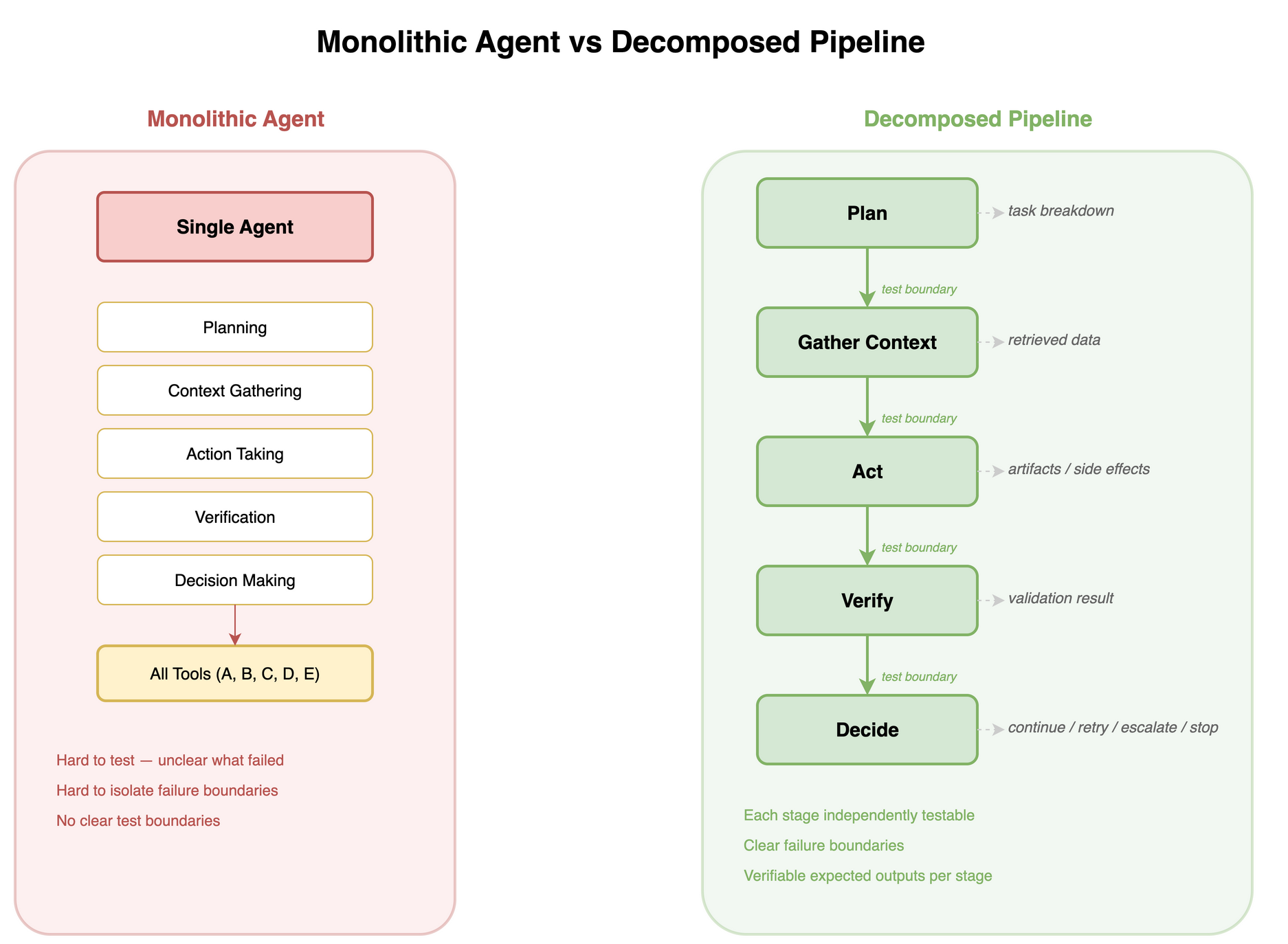
An agent given a broad instruction prompt and access to many tools is inherently difficult to test. When the outcome is wrong, it is hard to tell whether the failure came from poor planning, weak prompting, incorrect tool use, hidden assumptions, or an unintended side effect.
A more testable design breaks the system into narrower components or sub-agents with explicit responsibilities and outputs. For example:
- one component plans
- one gathers or retrieves context
- one takes action
- one verifies the outcome
- one decides whether to continue, retry, escalate, or stop
This decomposition creates two things: failure boundaries and test boundaries. When each stage has a clear purpose, it becomes easier to locate where things went wrong. And when each stage is expected to produce a specific outcome, it becomes easier to validate whether it actually succeeded.
The principle is simple: a stage is not complete because the agent says it is. It is complete when it has produced the expected outcome in a form the platform can verify.
Reliability with repeated success
Traditional software tests often ask a binary question: did the code pass or fail? That works for deterministic systems, but it is insufficient for agentic systems. An agent may complete a task in one run and fail in some of the runs when the same scenario is repeated 10 or 100 times. Such a system is not reliable in an operational sense.
That is why reliability for agents should usually be measured across repeated execution. The more useful questions are:
- how often does the system complete the task successfully
- how stable is its behavior across repeated attempts and realistic variations in context
- which failure modes recur most often and how recoverable they are
- what success threshold is acceptable for this class of task
This moves evaluation away from "it passed the test" and towards reliability scoring. That shift matters even more for workflows involving multiple agents, complex reasoning, and tool interactions.
In practice, that means running the same scenario multiple times, measuring the success rate, and deciding whether the result is good enough for the intended level of autonomy. For example, a scenario that passes 17 out of 20 runs has an 85% success rate. That may be fine for an assistant that drafts a proposal for human review, but not for one that applies changes unattended with a 95% target.
It also helps to be precise about what "success" means. pass@k (Chen et al., 2021) asks whether the agent succeeds in at least one of k attempts, which suits workflows where a retry or human pick is cheap. pass^k (τ-bench) asks whether it succeeds in all k attempts, which is the more honest measure when every run touches real systems. The two numbers can differ dramatically for the same agent.
Validate outcomes, not just dialogues
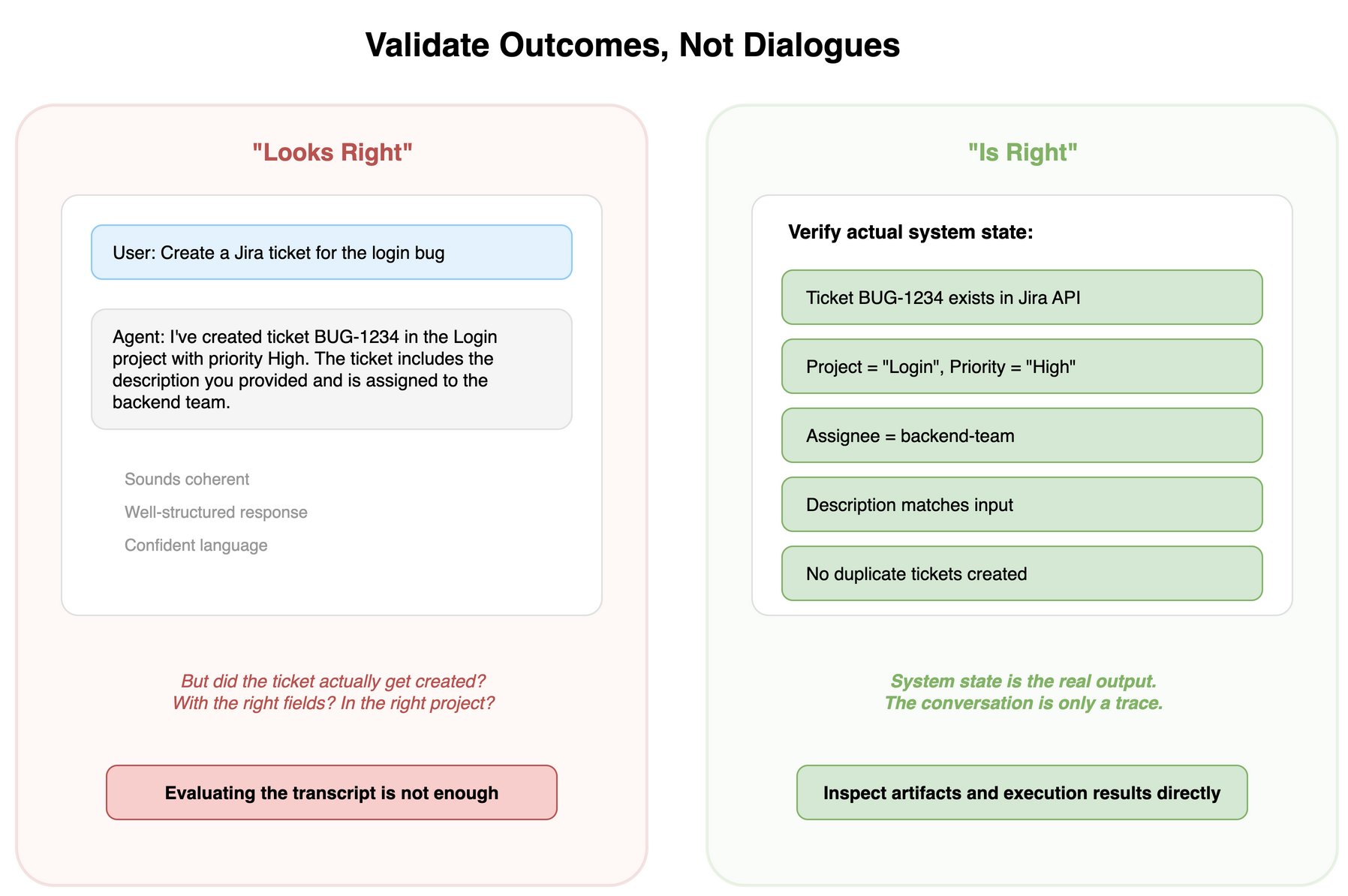
One of the easiest traps in agent evaluation is to over-focus on the transcript. A response can look coherent, cautious, and well-structured while the actual work is incomplete or wrong.
For action-taking systems, the primary object of testing should be the side effect:
- Did the system produce the expected artifact, change, or decision?
- Did it act on the correct resource, record, or environment?
- Did the action have the intended result?
- Did it avoid unintended changes outside its scope?
This matters because the system state is the real output. The conversation is only a trace of how the output was attempted.
Good testing therefore inspects artifacts and execution results directly. It checks the actual outputs of the system: changed records, created tickets, updated documents, emitted events, generated code, or downstream state transitions. It does not stop at "the explanation sounded right."
This also leads to a more mature style of assertion. Not everything needs byte-for-byte matching. Some outputs should be checked strictly, such as required schema fields or safety-critical parameters. Other outputs may need structural or semantic checks that allow harmless variation. Reliability improves when validation is strict where meaning matters and flexible where formatting variance is acceptable.
Execution is the real source of truth
Checking state tells you what the agent changed. Executing its output tells you whether that output actually works. An agent may produce an answer that looks plausible but does not hold up in execution. It can draft code that does not run, trigger a workflow with the wrong parameters, or make a recommendation that falls apart when checked against the underlying system state.
That is why testing agentic systems should end at execution wherever possible. For example:
- If the system writes code, run it.
- If it takes an action through tools or APIs, verify the resulting state.
- If it generates configuration or workflow steps, validate them in a safe environment.
- If it makes a claim about the world, check that claim against a trusted source of truth.
Execution closes the gap between "this seems reasonable" and "this actually works." With this step, the operational correctness of an agentic system can be measured.
Supervised autonomy as a reliability control
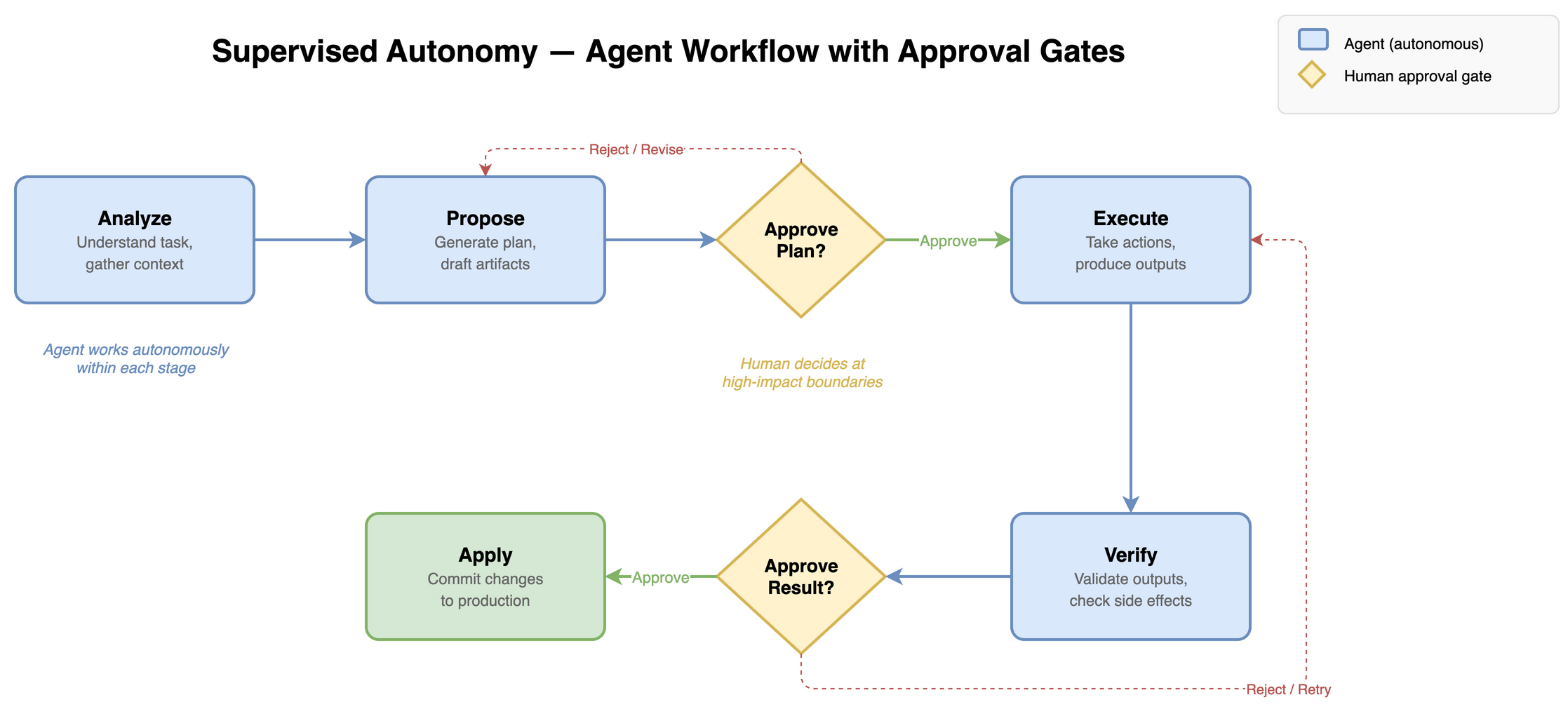
It is common to discuss autonomy as if more autonomy automatically means a better system. In practice, that is often the wrong optimization target. For many workflows, especially where changes are semantic or high impact, human approval is not a weakness in the design. It is a deliberate reliability control.
Approval gates are especially useful when the system is:
- making ambiguous decisions with business impact
- choosing between multiple plausible actions
- changing production-facing systems or user-visible outputs
- operating with incomplete domain context
In those cases, a strong pattern is supervised autonomy: let the system analyze, propose, prepare, and even draft the final artifacts, but require confirmation before irreversible or high-cost mutations. When the system is uncertain, or a run keeps failing verification, it should escalate to a human rather than retry indefinitely. For more on designing these checkpoints, see Responsible Agentic Workflows for Enterprise AI.
That improves reliability in two ways. It lowers the blast radius of wrong decisions, and it makes the workflow easier to reason about in tests because the expected path includes explicit pause points and decision boundaries.
Isolation makes failures containable and tests repeatable
Reliable agentic systems need controlled execution environments.
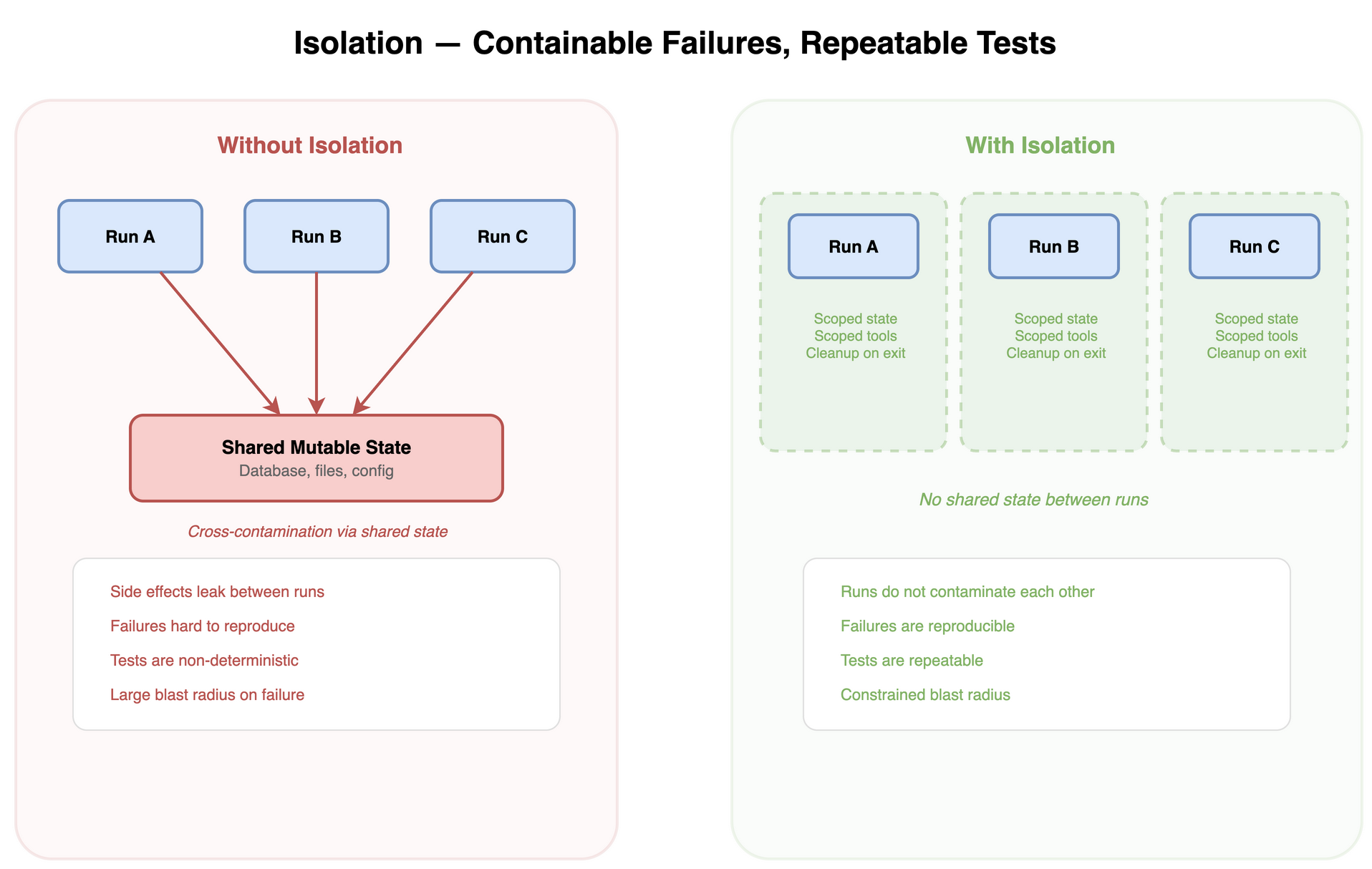
Isolation is often discussed as a security concern, but it is equally important for testability. If multiple runs share mutable state, side effects become harder to reason about and failures become harder to reproduce.
Isolation can take several forms:
- isolated execution contexts
- scoped permissions and resources
- temporary or reversible working state
- bounded tool access
- cleanup and rollback mechanisms
This gives two concrete advantages. Tests become more repeatable because runs do not contaminate one another. And operational risk becomes easier to manage because a failed or misbehaving agent is constrained to a smaller blast radius.
For systems that can write code, alter data, or modify infrastructure, isolation is not optional engineering hygiene. It is part of the reliability model.
Putting the principles to work
These principles are easier to understand when grounded in a concrete implementation. In one project involving agent-supported ELT workflows, they showed up in a practical way:
- the workflow was decomposed into narrower stages rather than one monolithic agent
- each stage was expected to return specific artifacts
- generated files were validated, not just described
- runtime execution was used to confirm correctness
- users were asked to approve semantic decisions before final changes were applied
- runs were isolated through session-scoped resources
The project itself is less important than the pattern it illustrates. Reliability did not come from a particularly persuasive prompt. It came from engineering constraints around the model. If your agents generate dbt code, Guardrails for AI-written dbt projects shows the same idea applied with automated checks.
Conclusion
The most useful way to think about reliable agentic systems is not "How do I make the model smarter?" It is "How do I make the system testable?"
Once agents can act on real systems, reliability depends on more than model quality. It depends on architectural boundaries, repeated-run evaluation, outcome validation, execution-based checks, human approval where needed, and isolated runtimes.
That is the shift that matters. Agentic systems stop looking like demos when they are built so their behavior can be tested, constrained, and trusted.
Written by

Prashant Srivastava
Machine Learning Engineer
Our Ideas
Explore More Blogs


Contact